
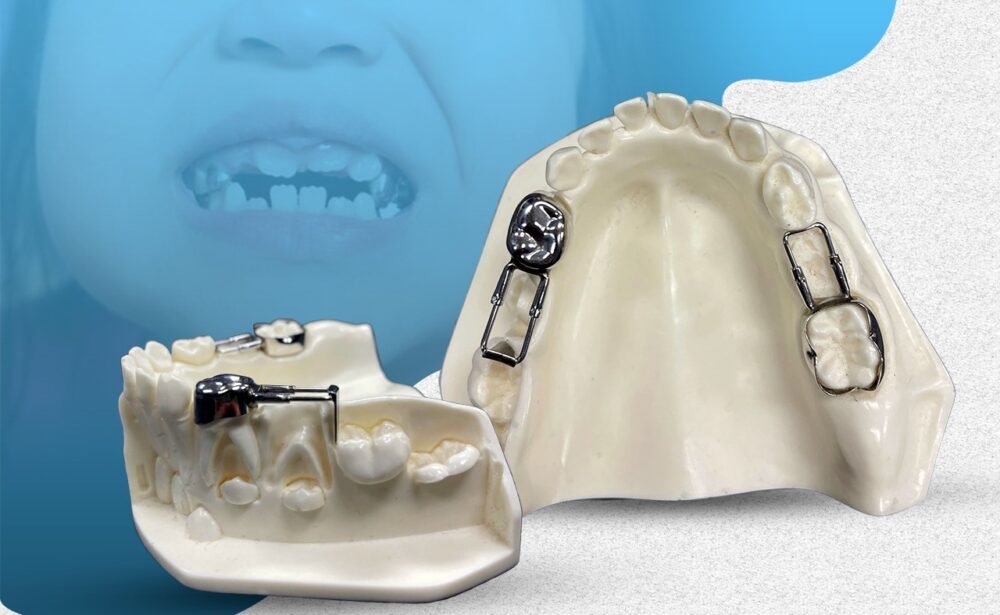
Space Maintainers
Space maintainers are orthodontic appliances used to help preserve space in a child’s mouth when a baby tooth is lost earlier than expected. Baby teeth play an important role in guiding adult teeth into their proper positions. If space closes too soon, it may contribute to crowding or misalignment when the adult tooth is ready to come in. A space maintainer helps keep this space available until the permanent tooth is ready to erupt.
Types of Space Maintainers
Space maintainers may be fixed (cemented in place) or removable, depending on your child’s needs. Common types include:
Band and Loop Space Maintainer
A metal band is placed around a back tooth with a small loop extending into the empty space to help keep it open.
Crown and Loop Space Maintainer
A stainless-steel crown is placed on a tooth with a loop that maintains space, often used when the remaining tooth requires extra protection.
Distal Shoe Space Maintainer
Used when a baby molar is lost before the permanent first molar erupts. A small extension helps guide the adult molar into the proper position.
Lingual Holding Arch (Lower Space Maintainer)
Attached to the lower molars with a wire that rests inside the lower front teeth to preserve multiple spaces.
Nance Appliance (Upper Space Maintainer)
Anchored to upper molars with a small acrylic pad on the palate, helping maintain space in the upper arch.
Removable Space Maintainer
A custom appliance that can be taken out as instructed, used in selected cases when appropriate.
How Space Maintainers Work
Once placed, the appliance holds the needed space until the permanent tooth is ready to erupt. Children may need a short adjustment period to get used to the appliance. Good brushing and regular dental visits are important to keep the appliance and surrounding teeth clean.
Who May Benefit
Space maintainers are generally recommended for children who lose baby teeth early due to decay, trauma, or natural early exfoliation. Your dental office will assess your child’s teeth and bite to determine whether a space maintainer may be helpful.
To learn more about space maintainers and whether they may be appropriate for your child, please contact our office to schedule a consultation.